Tuesday, May 10, 2011

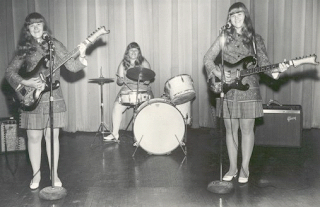
the shaggs - philosophy of the world


Rock music is an endless parade of recycled riffs and stolen images that has been trudging on for nearly sixty years.  Everyone rips off everyone else.  The only real key to success is ripping off the right people, a fact that's been true since the birth of rock 'n roll itself.


Elvis Presley covered all the right delta blues singers, the Beatles copied the right Chuck Berry licks, Brian Wilson stole the right Phil Spector techniques—it's a time-honored, reliable tradition that has resulted in some of the greatest music ever made.

True originality, however, is incredibly rare, so much so that it can arguably be traced back to only a few dozen artists. While it's impossible to create art without being at least partially influenced by outside forces, this elite group of artists managed to contribute unique ideas to an art form so firmly rooted in its own past that it often seems to oppose progress of any kind.

Chuck Berry, Kraftwerk, Black Sabbath, James Brown, the Velvet Underground, the Stooges, Run-D.M.C., the Ramones, Bob Dylan—without artists like these, modern music as we know it would cease to exist.

Yet this accepted canon of legends is almost always missing one of the greatest bands in history, a group so monumentally groundbreaking that they were declared “Better Than the Beatles,” a group that rewrote the very rules of pop music and inspired legions of followers to demolish every possible musical boundary available.

The Shaggs.

Their story is truly mythic in its sweep.

Three sisters, Dot, Helen, and Betty Wiggin, created a rock band in New Hampshire at the urging of their father, Austin. Austin's mother had made three palmreading predictions when he was a teenager, claiming that he would marry a strawberry blonde woman, have two sons after her death, and start a band with his daughters. After he indeed married a strawberry blonde and had two sons, he decided to continue on and make the third premonition come true as well.

Austin promptly took his daughters out of school in 1968 and signed them up for music lessons, effectively making music their top priority without their consent. The daughters dutifully practiced their instruments, naming their band “The Shaggs” after both the “shag” hairstyle and shaggy dogs. After less than a year, Austin booked his daughters studio time, and Philosophy of the World was released to an unsuspecting world.

There has truly never been an album quite like Philosophy of the World, and there likely never will be again.

It is impossible to overstate how wonderful this album is. Every preconceived notion of rock music, everything that had been taken for granted by artists for decades, was thrown out the window on this record. A steady beat, in-tune guitars, proper harmony, established melodies—all concepts completely overthrown by a schoolgirl trio.

The Shaggs are at once horrifically dissonant and primitively beautiful. Their music is unlistenable by modern standards, lacking any of the comforts that simple song structure provides, yet their lyrics are wonderfully innocent, juxtaposed violently against the tense amusical noise spewing behind it.

“My Pal Foot Foot” ostensibly follows the tale of a missing dog named “Foot Foot,” who is found by the protagonist at the end of the song. (Or the dog died, depending on how you interpret the piece.) “Philosophy of the World” is a shockingly honest depiction of class warfare and the enormous social pressures we face every day, ending with the most honest line in the history of music: “You can never please anybody in this world.”

The album bounces between childish themes and surprisingly mature treatises on existence in an effortless fashion, effectively bringing us into the chaotic world of a Christian schoolgirl growing up in the 60s.Philosophy of the World is a snapshot in time, a perfect depiction of musical innocence created rather forcefully by Austin Wiggin.

In many respects, the Shaggs are simply the vehicle of Austin, much like Malcom McLaren took a bunch of scummy London kids off the street and formed the Sex Pistols to fulfill his punk fantasies. But just as the Sex Pistols grew into a monster even Malcom couldn't contain, the Shaggs have ceased to become a “rock band” in the image Austin wanted them to be.

Over time, they've become an embodiment of the otherness of rock 'n roll, the true freedom rock 'n roll always offered yet nobody quite took advantage of. It's more avant-garde than the Velvet Underground, more punk than the Ramones, and more poetic than Bob Dylan, on a level none of them could even fathom reaching.

Thankfully, numerous artists have taken up the challenge posed by the Wiggin sisters, including Frank Zappa, Kurt Cobain, Ida, Deerhoof, R. Stevie Moore, and countless other musicians working to further push the limits of this whole “rock music” that continues to exist in the Shaggs' shadow.
For the more daring among you, the “Better Than the Beatles” tag will ring loud and clear throughoutPhilosophy of the World. For others, this column will amount to nothing more than rock journalism at its worst. Which is sad, but understandable.

In time, however, you'll come to know the truth: “Yesterday” and “A Day in the Life” are good songs and all, but they really can't compare to “My Pal Foot Foot.”

- 4/5/11


Saturday, May 7, 2011

sebadoh - live at the black cat, 3/26/11

I've been sympathetically described by my friends as “excruciatingly awkward.” I've been told I walk around like I'm completely lost, staring at the ground to avoid all possible eye-contact. I often daydream about building a teleportation device that would send me straight from my room to anywhere on campus, completely eliminating all unnecessary social interaction.


Naturally, I'm also a huge Lou Barlow fan.

Lou Barlow got his start playing in hardcore punk bands in the early 80s before joining the seminal alternative rock band Dinosaur Jr. with childhood friend J Mascis. After playing bass in Dinosaur Jr. for five years, the two had a legendary fallout, leading to Lou being fired in 1989. From there, Lou decided to focus on his solo career, recording noisy tracks under the name Sentridoh and reconnecting with an earlier side-project, entitled Sebadoh.

Barlow is a legend in the world of “lo-fi,” a genre characterized by rudimentary recording techniques and the use of four-track recorders. His songwriting is startling introspective, marked by deeply personal confessions and the stark display of his emotions and weaknesses. It's the kind of music you don't particularly want to be able to relate to, but once you can, it's an experience unlike any other.

This is loner music, through-and-through, made by a loner for loners. This is music for people who daydream about not having to talk to other people, like myself. So in proper fashion, I went to a Sebadoh concert on Friday alone, where I stood amongst other loners and sang songs with them about lost love and an increasingly fractured sense of self. An interesting experience, to the say the least.

Lou Barlow is exactly what I hope to be in twenty years. Who wouldn't want to be in their mid-forties playing loud, noisy, fun music for a living? Best of all, he's apparently managed to deal very well with his own personal awkwardness, something I struggle with constantly.

It was still there, noticeably apparent every time he pushed his bangs out of his face after songs and let them hang like a veil every time he launched into a brutally honest song about past relationships, but it was different. He had accepted it, made it a part of him, and even turned against his audience at times. (One interaction in particular stands out in my mind: “I love you Lou!” “Yes.”)

After playing thirty songs in incredibly frantic fashion, the band lumbered off the stage at the Black Cat, and I slowly made my back to the merch table to see what they had to offer. Lo and behold, none other than Lou Barlow was standing behind the ramshackle table selling t-shirts.

As I waited in line for my t-shirt, watching person and after person shake his hand and share some kind words, I was surprisingly calm. When I got to the table, I grabbed the t-shirt I wanted, gave him my money, shook his hand, and said the first thing that came to mind, which was probably the stupidest thing I could've possibly said:

“I've been a fan for a long time. Thank you.”

Two things to note there.

First, Sebadoh formed three years before I was born. Also, the albums they were touring to promote, Bakesale and Harmacy, came out when I was five and seven years old, respectively, and I didn't actually listen to them until I was almost out of high school. So the sight of a kid who must be like 16 years old telling him he'd “been a fan for a long time” must've been hilarious beyond words.

Second, I somehow managed to make that brief little exchange the most awkward experience of my entire life. I picked up a t-shirt, held out a twenty-dollar bill out in-front of me, and Lou stared at me like I was a crazy person. When he finally took the money, I reached out my hand to shake his, and he looked down at it like he had never shook anyone's hand in his entire life. When I spoke those unfortunate words, he smiled, nodded, and thanked me for thanking him. And then I walked away. It couldn't have been any worse.

It was only on my way home that I realized everything I should've said: “Bakesale and Harmacy and Sentridoh and your solo album all changed my life, your work with Dinosaur Jr. made we want to be a better bass player, and your bass line on 'In a Jar' is the absolute pinnacle of all recorded music.”
Oh well. Maybe next time.

- 3/29/11

Sunday, May 1, 2011

rebecca black - friday

Being the Internet man-about-town I am has a number of advantages, including the ability to learn about the many monstrosities spawned by the Internet before they seep into mainstream culture. I've managed to avoid some of the worst evils the Internet has to offer, from Rickrolling to 2Girls1Cup, and I can now add “Friday” by Rebecca Black to that prestigious list.


The first time I heard about Rebecca Black, I was convinced she was just some sick joke cooked up as the feminine counterpart to Justin Beiber. Accompanying the generic picture of some 13 year-old brunette, I found some of the most inane lyrics ever formed with the English language, like something Ke$ha would freestyle from the inside of a toilet bowl after a three-day bender:

Partyin’, partyin’ (Yeah) / Fun, fun, fun, fun / Lookin’ forward to the weekend.”

I had a laugh, looked at the endless stream of comments describing how unbelievably terrible it was, and went on with my life, never expecting to hear about it again.

That was Saturday, March 12th, a day after a Tosh.0 blog post opened up the song up to an unknowing audience across the Internet. The video only had a few thousand views, and Internet was still at peace.
As of Monday night, Rebecca Black's official music video has over 30 million views.

Somehow, this cheesy pop song, autotuned to hell and back, written by a tiny L.A. record label and recorded for $2,000, has become a phenomenon that threatened to overshadow one of the deadliest natural disasters in human history.

That's the Internet for you.

Honestly, I've yet to listen to this song. I've been fighting against it for weeks—especially since last Friday, when the fervor surrounding the song reached truly unbearable levels.

As endless links of the song and its many covers blanketed Facebook news feeds worldwide, I stuck to my guns, refusing to listen to a song Yahoo! Music actually declared “the worst song ever.” But I fear my time has finally come.

I've made similar stands against obnoxious pop songs in the past—including “Whip My Hair,” Justin Beiber's “Baby,” and everything Ke$ha's ever done—but I eventually ended up listening to them all, somehow. (I heard “Baby” for the first time at a family barbeque last summer. I laughed until I cried, and then debated its artistic merits with by 10 year-old cousin for hours.)

As a (technical) member of the music press, I feel that it would be downright irresponsible of me not to listen to a song so culturally significant. So here goes: my immediate reaction to hearing “Friday” by Rebecca Black for the first time.

(Three minutes and forty-eight seconds later.)

Not gonna lie... I'm a little disappointed.

It was only slightly less grotesque than 2Girls1Cup (though just as hilarious), but honestly, my musical palette is more offended by the average Glee episode.

Maybe I'm just turning into a grumpy old man, but this just sounds like pop music to me. The vocals are worse than usual, and the video is a whole other level of bad I'm not comfortable with addressing in this forum, but the song itself is simplistic, fun, and almost catchy for a few brief seconds at a time.

Leave the kid alone. There is much, much worse music out there. “Friday” is easily better than “TiK-ToK,” and judging by her unplugged performance on ABC News, she's already infinitely more talented than Ke$ha is.

If you really have that much personal hate for a 13 year-old singing a song about “lookin' forward to the weekend,” then you have a blackness to your soul that even I cannot begin to comprehend.

Let's be clear here: this is a terrible, terrible song, without a doubt. But it's inherently terrible.

To call it “the worst song ever” is completely missing its true nature. This is art circumventing the very definitions of art itself, vaulting itself into a level of intellectual brilliance so lofty that only the most truly unhinged fans of music, people completely free of all artistic, critical, and musical limitations, can appreciate it.

Critics around the world are tearing this song to pieces, just as they once ravaged Bitches Brew, Led Zeppelin, The Velvet Underground & Nico, and countless other works that were ahead of their time. No surprise there. But unlike my aging brethren, I'm not in the business of prematurely rejecting art I simply can't comprehend.

“Friday” will be hailed for generations to come as the breakout song of the “post-good” artistic movement, which will be carried on by the likes of Lil B, BrokeNCYDE, and the Black Eyed Peas in complete and unrelenting opposition to all critical forces that renounce them.

They will one day be recognized as the triumphant new carriers of the Dada torch, using it to burn everything in their path and build a new creative landscape where the old world once stood, enshrining their limitless musical forms as a model to wave after wave of bright young talent eager to break barriers where no previous barriers stood.

And I will be right beside them, championing them until my last breath.

I don't want this weekend to end...”

- 5/1/11