Friday, November 25, 2011

spokane - the proud graduates

The application of "-core" genres is admittedly a fickle, silly, and largely baseless practice, used almost entirely to lump together bands that probably shouldn't be lumped together, all to make said bands a little easier to describe. This is true, and I will not and cannot try to fight it.

What gets lost in conversations about this kind of arbitrary genre creation, however, is the fact that on occasion, these made-up genres actually kinda work.

To be fair, the vast majority of these "-core" genres are total crap. Metalcore, slowcore, rapcore, skacore, emocore, deathcore, noisecore, post-core--all real genres people have created to describe various types of music, all of which are completely ridiculous. Most of them are too generic to work (deathcore), some don't even describe the music accurately (slowcore), and some are just fucking insane (post-core).

Then there are the few that actually work. Hardcore stands out first and foremost, since it was the one that started them all, though few people would argue that hardcore wasn't a legitimate genre when it was coined. Grindcore has become a commonly accepted genre, largely because the criteria for the music is so simple--loud, fast, short.

Then there's a genre I'm quite fond of, though I very well might be alone on this one: sadcore.

I can almost hear the Internet groans from the two or three people who might read this, but I don't care. When I see that word, I can instantly come up with bands that fit the same style and sound: Ida, Bedhead, Rex, Red House Painters, Codeine, American Music Club, and now Spokane.

All of these bands share enough common attributes to lump them together: depressing lyrical content; understated musical tones; simple, guitar-based songs; the use of silence and atmosphere; and finally, the 90s.

I'm aware that fans of "skacore" would probably attempt to make the same argument, but goddammit, I think I'm right here. I wholeheartedly agree that the name "sadcore" is stupid, but a lot of genre names were stupid at the outset. Punk, jazz, hip-hop, and even rock'n'roll were ignorant, dumb terms that somehow came to stand for various types of music, so I reserve the right to use an ignorant, dumb term of my own.

Now that that's out of the way, The Proud Graduates is an album by the SADCORE band Spokane. And it's pretty good.

Spokane falls somewhere between Red House Painters and Ida at their most jangly, but they rarely climb up to the lofty tiers of either group. Rick Alverson's vocals fit the style, but he simply does not have the power of Mark Kozelek, Daniel Littleton, or Elizabeth Mitchell. The songwriting is just fine, and the instrumentation is lush and wonderful throughout, and you can't go wrong with this album...but you can definitely go better.

Sadcore isn't the most diverse genre in the world. Almost always, the difference comes down to the personalities of the frontmen/women, since their very souls tend to be projected onto the music itself. Which makes it easy to like bands like this, but hard to love them. There always tends to be another band that does the same thing but better, and in Spokane's case, there are plenty of them.

Wednesday, November 23, 2011

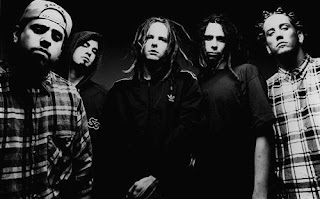
korn - korn

I was never a KoRn kid. When it came to angsty high school rebellion, I was more into writing Rage Against the Machine lyrics on desks than locking myself in my room and playing "scary" music. (My brother totally was though, and I will never let him live down his plastic-pants-from-Hot-Topic phase.) I always found it silly and overdone, in the same way I saw Marilyn Manson or any other Columbine-era shock-rock artist.

In hindsight, Korn was one of the few bands from the "nü-metal" genre that had any real substance, along with Deftones and probably no one else. Their core sound weakened over time, degrading into laughable songs like "Ya'll Want a Single," making it very easy to forget that Korn was a remarkably unique act when they first broke through, all the way back in 1994(!). The metallic slap-bass, growl-rapping, and tuned-down guitars they became known for quickly descended into self-parody and was picked up by numerous copycat acts, but taken for what it is, their trademark sound packs a tight, manic punch that still stands up to this day.

Jonathan Davis' aggressive lyrics brought them widespread attention from parent groups and politicians alike, and it's easy to forget that that controversy existed for a very good reason: Davis' psychotic delivery is thoroughly engrossing, and downright terrifying if you let yourself get sucked in deep enough. It's easy to dismiss as adolescent, the sound of an outcast lashing out at the ignorant world around him, but it's impossible to deny that the emotion underneath it all is real and true.

Fuck you! I'm fed up with you. I'm not as good as you?

Fuck no, I'm better than you.

Could those sentiments be processed better? Yes. But does he get his message across? Absolutely.
This is not subtle music, to be sure--the same general message is bashed across your skull nonstop for an hour--and it's easy to see why a confused, alienated 14-year old would use it as a weapon against his parents and society in general. But as a work of art, the manifestation of a world of horrible energy and restrained aggression boiled down to twelve songs, it is simply astounding.

This is not to say the album is flawless. The album is ripe with regrettable choices (the use of nursery rhymes in "Shoots and Ladders" is more cheesy than unsettling, for example), but they are far outweighed by the ones that work. The band is buoyed throughout by Davis, who is at his best when he lets his raw emotion pour through. And nowhere is this raw quality more evident than in "Daddy."

The unfortunate truth is that this song is about the real-life childhood molestation of Davis (not by his father, but by a female family-friend), and that the autobiographical nature of the song is what brings it to life. The track is nothing short of pure, unbridled pain. By the end of the song, you can almost hear the demons of his past leaving his body. The lullaby in the background are unnecessary, and even work to dilute the power of Davis' vocals (if you can call them that), which chill you right to your core.

As his words give way to agonizing screams, uncontrollable sobbing, and bellowing cries toward figures unknown, it becomes truly unsettling, truly uncomfortable to listen to. It's one thing to be moved by art. It's quite another to want to physically turn away from it. In my mind, "Daddy" stands up as one of the most frightening songs in rock history, up there with "Frankie Teardrop" and "Hamburger Lady," and is the perfect musical and emotional anchor to the album as whole.

The band never again reached the creative heights of their debut. Maybe the songwriting was never as good. Maybe the production on other albums polished them up too well. Maybe their energy simply peaked at the outset. For whatever reason, Korn's debut was as good as they ever got, and arguably created a "nü-metal" landmark that no other band could touch, far outlasting the ill-begotten genre and all the worthless bullshit it spawned.

Monday, November 21, 2011

the mountain goats - live: 1998/02/06 - cow haus, tallahassee fl

Here's an easy way to spot the difference between a Mountain Goats fan and someone who listens to the Mountain Goats:

Ask them what their favorite Mountain Goats album is.

If said person merely listens to the Mountain Goats, they will name a studio album. Most likely Tallahassee, All Hail West Texas, or the Sunset Tree. If they're trying to get cocky, they might even namedrop Sweden or Get Lonely.

If said person is a true Mountain Goats fan, he/she will either:

a. Hesitate, then ask you to define what exactly you mean by "studio album," or

b. Name their favorite Mountain Goats live recording.

Every good Mountain Goats fan knows that the albums/tapes/compilations are just the blueprints for live recordings. Even the best recorded Mountain Goats songs become infinitely better onstage, bar-none, without question. (Aside from songs that have never been played live, of course. Which, really, given the incredible amount of songs John has written over the years, are not that great in number.) John will write a song and put it down on tape, but it never really comes alive until he's pouring through it in front of an audience, tearing through every last note, dragging the emotion out of every last syllable, at times even seeming to create new emotions he discovered in the songs after he himself wrote them.

A good example of this is Sweden, which is a really an okay Mountain Goats tape, all things considered. It doesn't stand up to the later, greater stuff, but it definitely beats the hell out of some of his older monstrosities. Yet when those same subdued songs are played live, there is a life breathed into them that is nothing short of magical. They almost sound like covers, two versions of the same song, linked together by words and structure, yet vastly different in every other sense.

This exact phenomenon happens throughout my personal favorite MG show: 1998/02/06 at the Cow Haus in Tallahassee.

There are some shows where the fire burning inside John is so white-hot and pure, it damn-near sears your ears just listening to it. Forget broken strings--from 1995-2000(ish), it wasn't a good show if John's guitar wasn't covered in blood. John tends to look back at these shows unfavorably, openly mocking his past tendency to play songs as fast and loud as possible to gratuitous effect, one that is impossible to revel in, despite the knowledge of its disingenuous. If you don't get chills hearing John belt out lines like "You can arm me to the teeth / You can't make me go to war" at top-volume, you just aren't human.

Aside from the manic energy that pervades all recordings from that time, this show is exemplary for a few other reasons. For starters, the setlist is fantastic. "Tulsa Imperative," "West County Dreams," "Waving At You," "Snow Crush Killing Song," "Family Happiness," "Minnesota"--all of which are incredible choices, some arguably sounding at their absolute best in this recording. Clocking in at an hour and twenty minutes, it's also a fairly long show, burning through 24 songs in the process. Just when you think he's starting to fade, he comes roaring right back with even more energy than before. At one point he tells the crowd that he could keep going for three hours, and it's not hard to imagine him doing it, if he thought they would've stuck with him.

The sound quality is imperfect, but for a 13-year old recording, it's pretty excellent. There are slight rough patches to nitpick at, but if the sound is your biggest worry, then you really shouldn't be listening to shows like this in the first place. The balance is great throughout, if a bit low, so you should definitely jack the volume up using your media player of choice. One of the more common problems with these live recordings is poor audio during John's between-song banterings, and thankfully, every word that leaves his mouth that night rings through loud and clear. And as far as Mountain Goats banter goes, this is pretty good. No classic drunk-John lines, no interplay with Peter or anyone else, but plenty of audience dialogue and some choice song descriptions.

All-in-all, it's a tremendous experience, one that any Mountain Goats fan should partake in without hesitation, and one that would certainly open the eyes of "fans" who think the best Mountain Goats recording is a studio album. (Lol.)


(In case you were wondering, John has no problem with people sharing live shows online. Archive.org even has an email from him, giving his direct blessing.)